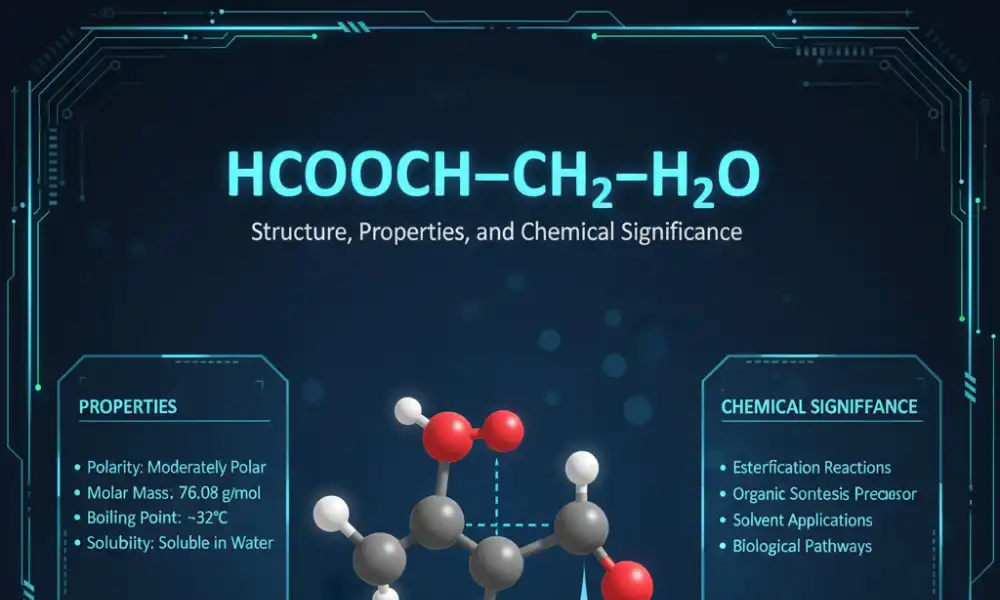
Chemistry is a world of infinite combinations and possibilities, where each molecular structure has its unique significance and application. One such compound that often intrigues students and professionals alike is HCOOCH–CH₂–H₂O. This formula, while appearing simple at first glance, hides fascinating layers of chemical bonding, molecular interactions, and potential industrial relevance. In this article, we will take a deep dive into the composition, structure, and characteristics of HCOOCH–CH₂–H₂O, exploring how it behaves, reacts, and is used in the scientific and industrial landscape.
1. Chemical Composition and Structural Overview
To understand HCOOCH–CH₂–H₂O, we must first decode its molecular formula. The chemical expression suggests the presence of formate (HCOO–), ethyl (CH₂), and water (H₂O) components. When broken down, this structure can be interpreted as a formic ester or a derivative involving formic acid (HCOOH) and an organic component.
Chemically, HCOOCH–CH₂–H₂O can be viewed as a hydrated formic ester, possibly representing methyl or ethyl formate in a hydrated condition. In hydration states, water molecules attach to the compound either through hydrogen bonding or chemical association, influencing its physical and chemical behavior.
In simpler terms, this molecule can exist as a formate ester with an associated water molecule, a scenario common in organic and biochemical systems where water plays a role as both a solvent and a reactive partner.
2. Formation and Chemical Reactions of HCOOCH–CH₂–H₂O
The synthesis or formation of compounds like HCOOCH–CH₂–H₂O involves esterification and hydration reactions. In a typical esterification reaction, formic acid (HCOOH) reacts with an alcohol (such as ethanol, CH₃CH₂OH) in the presence of an acid catalyst to produce a formate ester (HCOOCH₂CH₃) and water: HCOOH+CH3CH2OH→HCOOCH2CH3+H2OHCOOH + CH₃CH₂OH \rightarrow HCOOCH₂CH₃ + H₂OHCOOH+CH3CH2OH→HCOOCH2CH3+H2O
Here, the water molecule generated in the reaction can either remain free or form a weakly bonded association with the ester, resulting in a hydrated form—HCOOCH–CH₂–H₂O.
In laboratory conditions, hydration is often reversible. Under low humidity or high temperature, the water molecule may detach, while under moist conditions, it can reassociate, influencing boiling points and solubility.
This reversible hydration makes HCOOCH–CH₂–H₂O an interesting example of molecular dynamics, where physical properties are modulated by ambient conditions.
3. Physical and Chemical Properties
The physical properties of HCOOCH–CH₂–H₂O depend on its structural arrangement and degree of hydration. While the core ester group defines its reactivity, the presence of water significantly alters its physical characteristics.
a. Physical Properties:
- Appearance: Typically a colorless, volatile liquid with a pleasant fruity odor (similar to other formate esters).
- Boiling Point: Around 55–60°C, but the hydrated form may exhibit slightly higher boiling points.
- Solubility: Miscible with water and most organic solvents due to the hydrogen bonding capability of the associated H₂O molecule.
- Density: Around 0.9 g/cm³, depending on temperature and water association level.
b. Chemical Properties:
- Reactivity: Easily hydrolyzed back into formic acid and alcohol under acidic or basic conditions.
- Hydrogen Bonding: The attached water molecule enables intermolecular hydrogen bonding, affecting solubility and vapor pressure.
- Volatility: High volatility makes it useful in fragrance and solvent applications.
- Combustibility: Like other organic esters, it is flammable and should be handled with care.
These characteristics make HCOOCH–CH₂–H₂O versatile and relevant across various chemical and industrial processes.
4. Industrial and Practical Applications
Compounds related to HCOOCH–CH₂–H₂O, particularly ethyl formate (HCOOCH₂CH₃) and its hydrated versions, are used widely across different industries due to their pleasant odor, solvent power, and reactivity.
a. Solvent in Chemical Manufacturing
Ethyl formate and similar hydrated compounds serve as effective solvents for cellulose nitrate, varnishes, and resins. Their moderate polarity and volatility make them ideal for use in coatings and lacquers.
b. Food and Beverage Industry
Due to its fruity odor, hydrated ethyl formate derivatives are used as flavoring agents in foods and beverages. They contribute to the aroma of rum, pineapple, and raspberry flavors.
c. Pharmaceutical Uses
Hydrated formate esters are used as intermediates in drug synthesis. Their reactivity with alcohols and amines allows them to participate in forming essential organic compounds.
d. Insecticidal Applications
Ethyl formate, closely related to HCOOCH–CH₂–H₂O, has been used as a fumigant in stored grain protection due to its effectiveness against pests and insects while being relatively safe for humans when used correctly.
e. Research and Laboratory Usage
Chemists use hydrated esters like HCOOCH–CH₂–H₂O as model compounds in studying hydrogen bonding, esterification kinetics, and molecular interaction dynamics.
These wide-ranging applications underline the compound’s versatility and scientific importance.
5. Environmental and Safety Considerations
While HCOOCH–CH₂–H₂O and its analogs are generally considered safe in controlled quantities, handling precautions are essential.
- Flammability: The compound is volatile and flammable; thus, it should be kept away from open flames or heat sources.
- Toxicity: Inhalation of concentrated vapors can cause irritation of the eyes, skin, and respiratory tract.
- Environmental Impact: Biodegradable under normal environmental conditions, though large spills may affect aquatic ecosystems temporarily.
Proper ventilation, gloves, and goggles are recommended during handling. Industrial applications must comply with OSHA and REACH safety regulations for ester-based solvents.
6. The Chemical and Biological Relevance of Hydrated Esters
From a biochemical perspective, hydrated esters like HCOOCH–CH₂–H₂O provide insight into how water molecules influence organic reactions. In living organisms, hydration and hydrolysis reactions are fundamental to metabolic processes such as lipid breakdown, ester formation, and enzymatic catalysis.
The study of hydrated organic molecules helps researchers understand how solvation affects stability, reaction kinetics, and energy transfer. Hence, compounds like HCOOCH–CH₂–H₂O act as useful models in organic and physical chemistry research.
7. Future Perspectives and Research Opportunities
With the growing emphasis on green chemistry and sustainable synthesis, compounds like HCOOCH–CH₂–H₂O may find enhanced roles as eco-friendly solvents or renewable chemical intermediates. Scientists are investigating their potential as bio-based esters that can replace petroleum-derived chemicals.
Moreover, their simple structure makes them ideal candidates for studying molecular hydration dynamics, which could advance fields like materials science and catalysis.
Conclusion
In summary, HCOOCH–CH₂–H₂O represents more than a mere chemical formula—it embodies the interplay between organic esters and hydration chemistry. With its fascinating properties, wide industrial uses, and growing importance in research, this compound stands as a remarkable example of how structure defines function in chemistry.
Whether in laboratories, industries, or academic studies, understanding such molecules provides a clearer window into the chemical processes that drive both technology and nature.
Check Out Other related articles
- Candizi – The Natural Wellness Revolution You Need to Know
- Nahttypen: A Comprehensive Guide to Seam Types in Sewing and Textiles
- Cellulogia: The Revolutionary Non-Invasive Approach to Smoother Skin
- Tsunaihaiya – The Symbol of Japanese Craftsmanship and Cultural Harmony
- Seekde: Transforming Search into Smart Discovery and Learning
