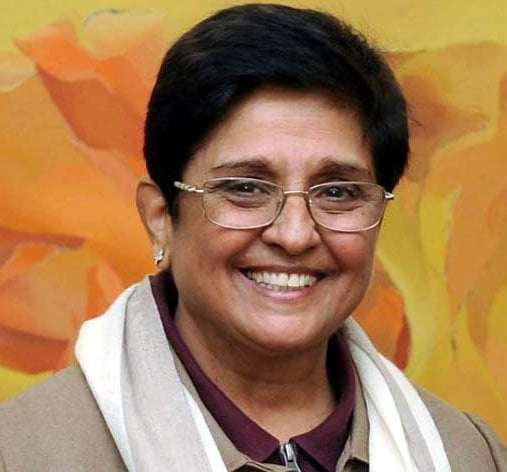
PERSONAL INFORMATION
Real Name: Kiran Peshawaria
Nickname: Crane Bedi
Profession(s): Politician, Civil Servant (retired IPS)
Famous For: Being the first female IPS Officer
Date of Birth: 9 June 1949 (Thursday)
Age (as of 2024): 75 Years
Birthplace: Amritsar, Punjab
Zodiac sign: Gemini
Nationality: Indian
Hometown: Amritsar, Punjab
Religion: Hinduism
Caste: Khatri [1] Glossary of the Tribes and Castes of the Punjab and North West Frontier Province By Sir Denzil Ibbetson, Maclagan
Food Habit: Non-Vegetarian
Marriage Date: 9 March 1972
Age: 75 Years
Check Out Other Celebrities Biography
- riya sharma pinjara khubsurti ka biography
- sonika tandi biography
- hande ercel biography
- ritika singh biography
- sona mohapatra singer biography
EDUCATION
School: Sacred Heart Convent School, Amritsar (1954)
College/University: • Government College for Women, Amritsar • Panjab University, Chandigarh • Delhi University, New Delhi • IIT, Delhi
Educational Qualification(s): • BA (Hons. in English) (1968) • MA (Political Science) • Law Degree from Delhi University (1988) • PhD (Social Sciences) (1993)
PHYSICAL STATISTICS
Height (approx.): in centimeters – 161 cm in meters – 1.61 m in feet inches – 5’ 3”
Weight (approx.): in kilograms – 55 kg in pounds – 121 lbs
Eye Colour: Black
Hair Colour: Black
FAMILY & RELATIONSHIPS
Marital Status: Widow
Affairs/Boyfriends: Brij Bedi (Tennis Player)
Husband/Spouse: Brij Bedi (Tennis Player); died in 2016 of cardiac arrest
Children: Daughter – Sukriti (Saina) (born in September 1975)
Parents: Father – Prakash Lal Peshawaria (Textile Businessman) Mother – Prem Lata
Siblings: Brother None Sisters • Shashi • Reeta Peshawariya (Tennis Player, Writer) • Anu (Tennis Player)
Husband: Brij Bedi
CAREER HIGHLIGHTS
Awards, Honours, Achievements: 1968: NCC Cadet Officer Award. 1979: President’s Police Medal for Gallantry for her role in preventing violence during Akali-Nirankari clashes. 1994: Ramon Magsaysay Award for government service. 1995: Lion of the Year by Lions Club, KK Nagar for community service. 2004: United Nations Medal for outstanding service. 2005: Mother Teresa Memorial National Award for Social Justice by All India Christian Council for reforms in prison and penal systems. 2006: Most Admired Woman in the Country by The Week magazine. 2014: L’Oreal Paris Femina Women Award for social impact.
MONEY FACTOR
Car Collection: Maruti 800 (Regn. No. DBB239) Model 1985
Assets/Properties: Movable Banka Balance Worth ₹2.5 Crore (approx.) Jewellery A pair of ear tops weighing 5 gm; worth ₹27 thousand Immovable • 4.76 acre agricultural land worth more than ₹1 Crore in Village Mirawadi, Taluka Daund Distt. Pune, Maharashtra • 2 acre agricultural land worth more than ₹50 lakh at Village Siwana, Sub Distt. Bhondsi, Gurgaon, Haryana • 5113 sq.ft industrial plot worth more than ₹30 lakh at Industrial Development Colony, Amritsar • 1938 sq.ft residential flat worth more than ₹4 Crore (First Floor, 56, Uday Park, New Delhi) • 1414 sq.ft residential flat worth more than ₹1 Crore (Flat No.301, Janki Co-op Group Housing Society, Plot No.7, Sector-22, Dwarka, New Delhi) • 3229 sq.ft residential flat worth more than ₹1 Crore (F-07, Plot No.01, P-7, Builders Area Greater Noida Dist. Gautam Budh nagar, Uttar Pradesh)
Salary (as the Governor of Puducherry): Rs. 3.5 lakh (as of 2018)
Net Worth (approx.): Rs. 11 Crore (as in 2014)
OTHER INFORMATION
Service: Indian Police Service (IPS)
Batch: 1972
Cadre: Arunachal Pradesh-Goa-Mizoram-Union Territories (AGMUT)
Major Designation(s): 1975: Sub-Divisional Police Officer at the Chanakyapuri Police Station in New Delhi. 1979: DCP Delhi’s West District. 1981: DCP (Traffic) Delhi. 1983: SP (Traffic) Goa. 1984: Deputy Commandant (Railway Protection Force in New Delhi). 1984: Deputy Director (Department of Industrial Development). 1985: Assigned to the Police Headquaters, New Delhi. 1986: DCP of Delhi’s North District. 1988: Deputy Director (Operations) in the Narcotics Control Bureau (NCB), Delhi. 1990: Deputy Inspector General (Range), Mizoram. 1993: Inspector General (IG) of the Delhi Prisons. 1995: Additional Commissioner (policy and planning) at the Police Academy, Delhi. 1996: Joint Commissioner of Police of Delhi Police. 1997: Special Commissioner (Intelligence) of Delhi Police. 1999: Inspector-General of Police in Chandigarh. 2003: Appointed the United Nations Civilian Police Adviser. 2005: Director General, Home Guards. 2007: Director General of the Bureau of Police Research and Development. In November, she resigned from the Police Service; citing personal reasons.
Political Party: Bharatiya Janata Party (BJP)
Political Journey: 2015: Joined BJP and was projected as BJP’s Chief Minister (CM) candidate for the 2015 Delhi Assembly elections; however, she lost the election from Krishna Nagar constituency to AAP candidate SK Bagga by a margin of 2277 votes. 2016: On 22 May, appointed as the Lieutenant Governor of Puducherry. 2021: On 16 February, Rashtrapati Bhavan withdrew Ms Bedi from the post of the Lieutenant Governor of Puducherry.
Address: 56, First Floor, Uday Park, New Delhi-110049
Hobbies: Playing Lawn Tennis, Photography, Travelling, Reading, Writing
Sport: Lawn Tennis
Politician: Narendra Modi
INTERESTING BACKGROUND INFORMATION
Kiran Bedi’s lineage traces back to her great-great-grandfather, who made the significant journey from Peshawar to Amritsar. This rich heritage provided a unique backdrop for her upbringing, as she was immersed in both Hindu and Sikh traditions. Growing up in a family where sports were celebrated, her father, an active Lawn Tennis player, inspired her to pick up a racket at just nine years old. This early introduction to the sport ignited a passion that would see her reach impressive heights, playing professional Tennis at the national level. Her remarkable talent was showcased when she was part of the Indian team that clinched the Lionel Fonseka Memorial Trophy in Sri Lanka in 1973. Bedi’s decision to sport short hair is often attributed to her Tennis endeavors, as she found long hair cumbersome while competing on the court.
During her formative years, Kiran Bedi was an active participant in her school’s National Cadet Corps (NCC) and engaged enthusiastically in various extra-curricular activities. After graduating with a Master’s degree in Political Science from Panjab University, Chandigarh, she took on the role of a lecturer at Khalsa College for Women in Amritsar from 1970 to 1972. It was during this period that her aspirations began to take shape, inspired by civil servants she encountered at the Service Club in Amritsar, where she also met her future husband, Raj Bedi. This motivation led her to join the Indian Police Service in 1972, after which she underwent nine months of rigorous training at Mount Abu in Rajasthan.
Bedi’s groundbreaking career in law enforcement began with her first posting to the Chanakyapuri subdivision of Delhi in 1975, where she made history as the first woman to lead the all-male contingent of the Delhi Police at the Republic Day Parade. Her adept handling of high-pressure situations quickly became apparent when she effectively managed civil unrest during the clashes between Nirankari and Akali Sikhs in November 1978. For her brave efforts, she was awarded the Police Medal for Gallantry by the Indian President in October 1980. In 1979, she implemented innovative community policing strategies that significantly reduced crime in West Delhi, utilizing civilian volunteers for night patrols and establishing open channels for citizens to voice their complaints directly.
As her career progressed, Kiran Bedi continued to tackle pressing challenges. In October 1981, she took on the role of DCP (Traffic) in Delhi, where she adeptly managed traffic crises during the 1982 Asian Games. Her innovative approach included replacing traditional fines with spot fines and collaborating with various organizations to streamline traffic management. This earned her the nickname ‘Crane Bedi,’ particularly after she courageously enforced traffic laws by towing away the improperly parked vehicle of the Prime Minister’s Office. Although she was offered the ‘Asian Jyoti’ award for her exemplary work during the Games, she humbly declined it, insisting that it be dedicated to her entire traffic unit. Bedi’s career trajectory took her to Goa in 1983, where she faced personal challenges as her daughter battled a serious illness. Despite this, she continued to earn recognition for her groundbreaking work, establishing detox centers to combat drug addiction and formalizing them into the Navjyoti Police Foundation for Correction, De-addiction, and Rehabilitation.
Bedi’s transition into higher roles continued in the 1990s. After being moved to Mizoram as Deputy Inspector General (Range) in 1990, she earned accolades for her work while also advancing her academic pursuits. By 1993, she was appointed Inspector General for the Delhi Prisons, where she pioneered transformative reforms, such as introducing Yoga and Vipassana sessions for inmates and implementing vocational training programs. Her groundbreaking contributions earned her prestigious awards, including the Ramon Magsaysay Award and the Jawaharlal Nehru Fellowship. Beyond her law enforcement career, Bedi was recognized for her advocacy against corruption, co-founding the India Against Corruption movement alongside prominent figures like Arvind Kejriwal and Anna Hazare. In 2015, she embraced a new chapter by entering politics with the Bharatiya Janata Party (BJP) and also made her mark in media by hosting the popular TV series ‘Aap Ki Kacheri’ on Star Plus, demonstrating her versatility and commitment to serving the public in various capacities.
—
Note: All biographical information compiled from publicly available sources.
